
When Talking Alone Is No Longer Enough
In the work of supporting others—whether as a coach, therapist, counselor, or leader—there are moments when a good conversation brings relief but no real change. We talk about the case, the situation, and the feelings. Yet the actual pattern remains hidden. This is precisely where the systemic approach opens up a different space.
Supervision and intervision are two of the most effective formats for professional reflection. They help people gain perspective, identify blind spots, and develop new courses of action. When designed in a systemic—and, additionally, visual—way, the result is something that goes beyond mere discussion: a vivid picture of the system in which the participants suddenly recognize themselves.
What Systemic Visualization Can Achieve in Supervision
Systemic constellations in a supervision or intervision context mean that what was previously only described verbally takes on a physical form in the room. Relationships among the participants become visible. Roles, loyalties, areas of tension, and resources can be observed from the outside—and this fundamentally changes one’s perception.
Anyone who has ever seen how an image appears on the VISTEMA®Anyone who has seen how a constellation can get a stalled supervision session moving again understands why visual systems work is increasingly being used as a standard tool in coaching training programs and supervision formats. Constellations make the unspeakable speakable—without the need for long explanations and without anyone having to provide the „correct“ interpretation. The image speaks for itself.
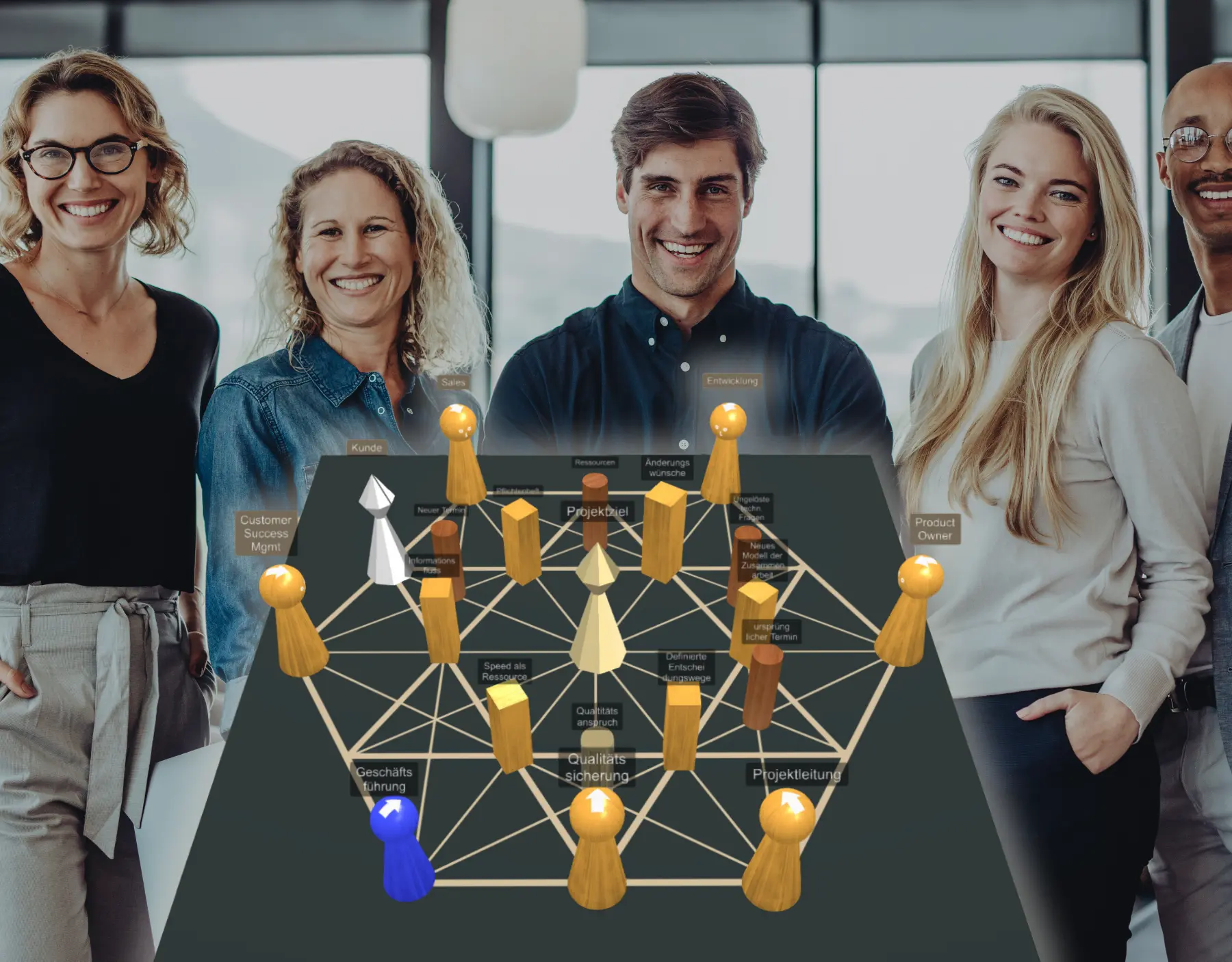
With a digital system board like VISTEMA® This process can be conducted in real time, regardless of location. Individuals in remote settings, group supervision sessions with participants from different cities, hybrid supervision sessions—all of this becomes possible without sacrificing the depth of the process. The digital format fosters a unique kind of focus: all participants are looking at the same image and sharing the same point of reference.
Systemic Intervision: Peer Groups at a New Level
Intervision—peer-led consultation without an external facilitator—thrives on mutual trust and a willingness to share one’s own cases. When peers work together on a digital system board, the dynamic changes fundamentally. Instead of a case report, a collaboratively designed map emerges: Who is in the system? What relationships exist? Where are the tensions, the resources, and the blind spots?
Constellation work in an intervision context also protects against a common pitfall: the “solution-proposal marathon.” Instead of receiving five well-meaning pieces of advice, the person presenting the case gains their own insight through the image on the board—an insight anchored by what they directly experienced during the constellation process. This kind of insight has a lasting effect because it comes from within.
In addition, the digital system board offers further possibilities: positions can be adjusted in real time, hypotheses can be tested through small shifts, and the entire process remains transparent to all participants. This strengthens mutual understanding and enhances the quality of collegial reflection. Especially in well-established intervision groups, a shared visual language develops over time, which facilitates communication and allows for deeper insights to be reached more quickly.
Systematic Supervision: Identifying Structures Rather Than Managing Symptoms
Professional supervision explores the background of transference, one’s own role in difficult situations, and systemic patterns that recur time and again. The conversation-based format sometimes reaches its limits—especially when the person being supervised is caught up in a complex web of relationships and has lost sight of the bigger picture.
The system board brings this web of relationships out of the mind and into the room. Suddenly, the supervisor sees how they themselves relate to the client, the client organization, the institution, and their own professional role. They see where they are too close. Where they have removed themselves from the picture. Where a loyalty is at play that hasn’t even been articulated yet. This is often the moment when supervision shifts from a venting session to a genuine catalyst for growth.
Supervisors who use a systemic approach report that constellations regularly lead to turning points in the supervision setting. Not because a “smart” person provides a solution, but because the system itself speaks—if you give it space and form. The person being supervised then doesn’t have to first translate what they’ve seen into words: it’s already there, visible to everyone in the room.
Another advantage that is often underestimated in practice is the time saved. What sometimes takes several sessions in a purely conversational format—recognizing a pattern, becoming aware of one’s own position within the system, or experiencing a shift in the system—can be achieved in a short amount of time through a well-facilitated constellation. This makes systemic visualization particularly attractive for supervision formats with limited time frames.
VISTEMA® as a tool for systemic reflection formats
VISTEMA® was developed to digitally replicate this very process—without losing any of its depth. The digital system board makes it possible to intuitively place figures, symbols, and positions and move them in real time. Multiple people can work on the board or watch at the same time. The process can be documented and reviewed together later.
What VISTEMA Does® Particularly well-suited for individual supervision in an online setting, where the coach and supervisee work together on the board. It is also ideal for group intervision sessions with multiple participants who have simultaneous access to the board. This format is also ideal for training supervision: trainees present their own cases and receive immediate feedback through the diagram—both from the group and from the system itself. And last but not least, it is well-suited for team supervision, where the dynamics within the support team itself are examined.
The Many Applications of VISTEMA® —from coaching and therapy to management and training—reflect the breadth of supervision and intervision today. The digital system board accommodates this diversity with a format that can be adapted to the group, the context, and the specific needs. Anyone who wishes to can use VISTEMA® integrate into existing supervision models without changing the entire format.
Systemic reflection means taking a holistic view
Supervision and intervision are not luxuries; they are professional necessities. Anyone who works regularly with people, who bears responsibility, who supports, advises, or leads others needs spaces where they can reflect on their own actions. When structured systemically, these spaces become more than just a way to relieve stress: they become places of learning where patterns can be recognized and changed.
What makes the combination of systemic constellations and a digital system board so special is its accessibility. No travel, no shared physical space—and yet a genuine encounter within the system. For many practitioners, this is the decisive step: finally integrating reflection into everyday life in the way that professional facilitation work deserves.