

When the room goes digital, the system remains the same
Anyone who works with systemic constellations knows that it involves much more than simply placing people in a room or figures on a board.
The goal is to make relationships, dynamics, and connections visible and tangible. People take positions, orient themselves toward one another, and react to closeness, distance, lines of sight, and changes in the field.
It is precisely this representative perception—this ability to empathize with another’s perspective—that is one of the distinctive qualities of constellation work. Representatives perceive, from their respective positions, what is felt there—physical sensations, emotional reactions, impulses to move, attraction, or distance. In the process, information may also emerge that had not been expressed before or that the participants themselves were not aware of.
A constellation thus does more than just reveal relationships and structures; it provides insight into how a system feels and is experienced from different perspectives.
For many years, this space was, quite naturally, a physical space. People stood together in a seminar room, representatives took their places, and a system board was used at the table.
As coaching, consulting, and professional development became increasingly digitized, a very simple question eventually arose: Can this be done online?
At first, this question was indeed open-ended. Today, after more than six years of experience with digital constellation work, it no longer arises for us.
For we have seen that even in the digital space, something emerges that is difficult to describe in technical terms: a shared space of interaction where people perceive, empathize with one another’s perspectives, respond to one another, and experience a sense of connection—even though the participants may be hundreds of kilometers apart.
Constellation Work Without a Shared Location
One of the most obvious advantages of the online game board is that it can be used from anywhere.
A practitioner in Vienna can work with a client in Hamburg; one representative is based in Zurich, and another might be in Berlin or on another continent.
Everyone sees the same lineup. Everyone is going through the same process.
This opens up new possibilities, especially for facilitators who work with people. The pool of potential representatives is no longer limited to those who can be in a specific place on a specific day. People can join from anywhere. Groups can be formed differently, appointments can be organized more easily, and people who would be unable to travel for an in-person constellation can also be included.
What interested us most, however, was not the organizational convenience. The real question was: Does this approach still work?
Our experience clearly shows that, yes, it does.
We have witnessed constellations in which people from different countries worked together, and yet a shared space emerged very quickly. Representatives perceive, respond to changes, describe differences, experience physical or emotional reactions, and develop impulses for movement.
The physical distance between people does not automatically lead to a sense of distance in the process. For us, this was one of the most significant lessons we learned in the early years. After all, “digital” does not necessarily mean “distant.”.
A shared space for collaboration can also be created online
Anyone who has worked with constellations for a long time is familiar with this unique experience: A group begins to work, and at some point, something changes. The group’s focus intensifies. People begin to respond to one another. Insights emerge, sometimes before much has even been said.
Many exhibitors initially assume that this very quality must be lost online. We, too, didn't know at first what would be preserved in the digital space.
Today, based on our experience, we can say: Nothing is lost—it just takes on a different form.
When people engage in a constellation exercise—looking at the same image together and sharing their perceptions—a shared space for interaction emerges, even through a screen. For those involved, it does not feel like a technically limited version of in-person work.
On the contrary: After a short time, the technology usually takes a back seat. The focus is on the setup.
That is precisely why we no longer view digital constellation work as a stopgap solution for situations in which an in-person constellation is not possible. It is a distinct form of work with its own unique qualities.
What Has Changed With the Digital System Board
The basic principles remain the same.
People, topics, goals, obstacles, or resources are represented. Proximity and distance take on meaning. Directions of gaze alter perception. Representatives take up positions and sense what emerges there.
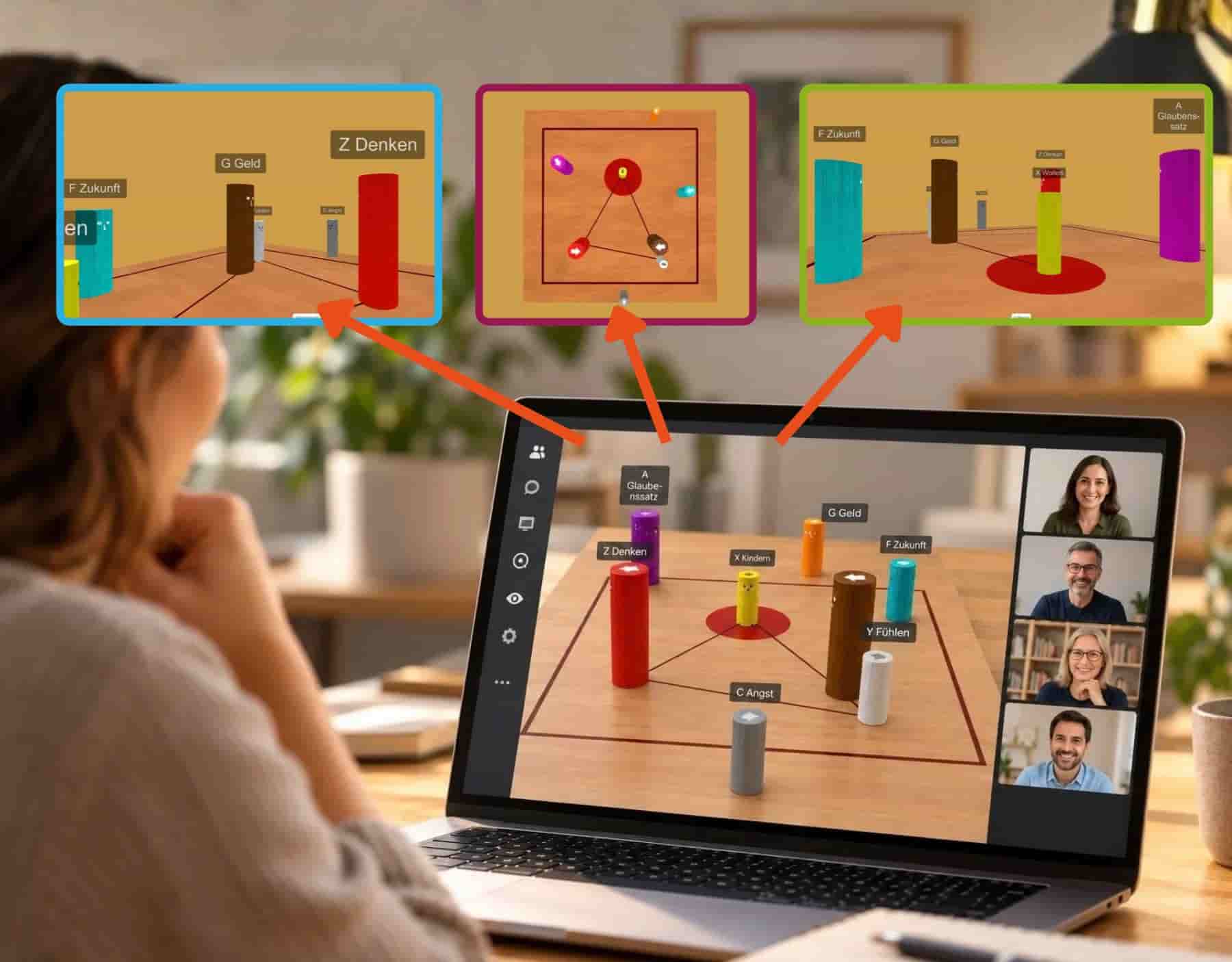
With the interior views in VISTEMA®-However, the Board brings together possibilities that we have come to know from various forms of constellation work—and something new emerges from this.
One of the great strengths of the classic system board is that it allows you to view the entire system from the outside. Relationships, distances, lines of sight, and changes become visible at a glance. The person looks at their system.
In a constellation with representatives, something different happens. The representatives stand at the center of the system. They experience the situation from a specific position and perceive what manifests there physically, emotionally, or as an impulse to move. Clients often observe this process from the outside at first and only later—or at the end—enter the constellation themselves.
The interior views connect both levels.
Clients can observe the entire constellation process from different perspectives. They not only see where a figure is standing, but also directly experience what the system looks like from that vantage point: Who is standing across from me? Who is close by? Who is far away? Who do I see? Who is outside my field of vision?
At the same time, they can empathize with that situation and sense what is changing there.
This creates a direct connection between inner experience and the visible image. For example, if someone feels small, overwhelmed, excluded, or very close to another person, this experience can be depicted in an image. The person can then look at the situation again from an inner perspective and ask: Does this image actually correspond to my experience? Does it make more sense as a result? Or does it reveal something else?
This alternation between perception, visual representation, and reliving the experience makes the process particularly impactful for clients.
This also adds an extra dimension to working with floor anchors. Anyone who steps onto a floor anchor can immediately put themselves in that position. In the digital space, the visual perspective comes into play: the other person is actually visible, as are their distance, size, line of sight, and position in the room. So the person not only imagines themselves in a position, but also simultaneously views the system from that position.
And unlike with a traditional system board, it does not remain exclusively in the third-person perspective.
You can switch perspectives at any time: from the overall view to an interior view of a character, from there to another position, and then back to the view of the entire system.
This often allows people with little experience with constellations to quickly gain access to representational perception. The visual perspective provides orientation and makes it easier to empathize, without dictating what should be perceived.
In this way, the internal perspective combines the overview provided by the system board, the immediate perception from a representative position, and positional work using floor anchors. At the same time, an additional dimension emerges: internal experiences can be made visible, viewed from the respective position, and immediately compared with one’s own perception. Future changes can be ‘tried out’ and experienced.
Over the years, this is precisely what has led us to develop our own unique form of digital constellation work.
Six years of experience have changed our perspective
When we began digitizing the system board, our primary goal was to make it possible to conduct familiar constellation work online.
Our perspective changed very quickly. We began to observe the possibilities that arise specifically through digital work. What began as a solution to physical distance has evolved into a distinct form of constellation work.
In addition, there is the option to save constellations. A process doesn't have to disappear at the end of a session. It can be reopened later. Developments across multiple sessions remain traceable.
And a meeting may be recorded—provided, of course, that all participants consent.
This can be particularly interesting for constellation facilitators. A constellation session often unfolds at a very fast pace. Many things happen simultaneously. Statements, movements, reactions, or small changes can only be consciously perceived to a limited extent during the process.
A recording allows you to review the material later, analyze the connections, and gain a deeper understanding of the process.
What happened and when? What change preceded a reaction? What observation was perhaps initially mentioned only in passing but later became significant? Where did a shift occur within the system?
It can also provide valuable material for supervision, training, research, or one's own professional reflection.
And yet, it's still constellation work
Perhaps that's one of the most important points.
The digital system board does not detract from the fundamental concept behind the constellation work.
It does not replace experience, perception, or the facilitator's expertise.
It's a tool.
However, one that transcends certain boundaries of physical space.
You could compare it to a horse-drawn carriage and a car.
A horse-drawn carriage can be beautiful. It has a charm all its own and is part of the history of transportation. For an occasional outing, many people would even prefer it to a car.
Even so, most of us wouldn't ride in a horse-drawn carriage for our daily commute these days.
Not because it's bad.
But because the possibilities have changed.
Similarly, we are now seeing this dynamic play out between the traditional system board and today's VISTEMA®-Board.
The physical board and traditional constellation work remain an important foundation of our work. At the same time, the question of whether digital constellation work is possible is less of an issue for us today.
A much more interesting question is why we should forgo the possibilities offered by the digital space when they enhance our work—both online and in person.
Maybe you just have to experience it for yourself
There is a lot to be said about digital constellation work. However, there comes a point where explanations don't get us very far.
Anyone who has experienced firsthand how a constellation takes shape with people from different locations, how representatives resonate with one another, how insights emerge, and how naturally everyone begins working with the digital board after just a short time will quickly understand why we wouldn’t want to do without this way of working today.
That's exactly what VISTEMA was designed for®-The board has been continuously refined over many years.
Not to reinvent constellation work, but to give it as many possibilities as possible in the digital space.
So anyone who has worked exclusively with a physical system board or in in-person groups up until now doesn't have to give anything up. It's just an addition.
A workspace that is accessible regardless of location. Representatives who can participate from anywhere in the world. Insights that directly help participants empathize with a particular perspective. The ability to create constellations that can be saved, analyzed, and continued. Changes that are not only felt but also made visible. And processes that can be reviewed and evaluated at a later time.
After six years of digital positioning work, our experience is therefore as follows:
A shared space does not come about simply because everyone is in the same room. It arises when people connect with one another and engage in the shared process.
And that's exactly what VISTEMA does® Also available digitally.
If you work with constellations yourself and want to know what it's like to use a digital system board in your work, then give this a try VISTEMA®-Board It's that simple. Some differences can be explained. Others can only be understood once you experience them.
